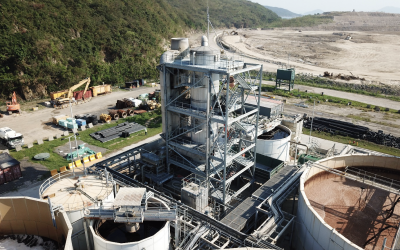
Introduction Organics Ltd, with its head office located in the industrial West Midlands of England, has its origins in the UK landfill gas and leachate industry. Organics now provides a comprehensive, industrially based manufacturing service, with offices, fabrication...
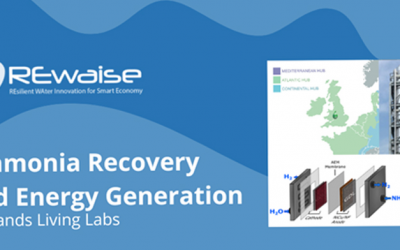
Every wastewater treatment plant spends money getting rid of ammonia. At Severn Trent Water alone, aeration to oxidise ammonia to nitrate costs around £1 million a year, burning through 10 GWh of electricity and generating roughly 5,000 tonnes of CO2 in the process....
Ammonia production accounts for between 3% and 5% of the world's natural gas production. This consumption equates to between 1% and 2% of the world’s energy supply. Here on earth, it requires a great deal of effort to produce ammonia. The following article,...
Veolia’s NENTX landfill extension near Fanling, Hong Kong needed an ammonia stripping plant (ASP) capable of handling 2,000 m³/day of leachate, cutting ammonium (NH4) from 4,500 mg/l down to under 200 mg/l, on a site where land is expensive and the climate swings from 10°C to 35°C with humidity up to 90%. Organics designed the system. What follows is the actual engineering reasoning and specification behind it — not a marketing gloss.
Four ways to remove ammonia from leachate and why thermal stripping won
Four routes exist for pulling ammonia out of leachate. Each was assessed against the same site: constrained land, no appetite for a chemical-heavy operation, and a requirement for consistent long-term performance.
Biological removal (Sequencing Batch Reactor). Bacterial nitrification/denitrification works, but it’s a land-intensive process — SBRs need large tank volumes and retention time to keep a bacterial colony alive and active, and at 4,500 mg/l influent NH4 the colony would need to process a heavy nitrogen load continuously. It’s also often carbon-limited: denitrification needs an external carbon source (typically methanol) when the leachate’s own BOD isn’t sufficient, adding a recurring chemical cost. Biological systems are also more fragile — a toxic shock load (common in leachate, which can carry heavy metals and variable organics) can knock out the colony and take weeks to recover.
pH-driven ammonia stripping. This avoids biology but replaces it with a different consumable: caustic (typically NaOH) to push pH up to ~10.5–11 where ammonia converts to its volatile, strippable form, then acid to bring the treated stream back down before discharge. At 2,000 m³/day and 4,500 mg/l NH4, the chemical dosing volumes are substantial and recurring — this is an ongoing opex line, not a one-time cost.
Steam stripping. A legitimate thermal alternative, but it requires a more elaborate process train — additional heat exchange stages and steam generation/injection equipment beyond what a thermally-driven air stripper needs. More equipment in the train means more capital cost and more maintenance surface area.
Thermally driven ammonia stripping (the option chosen). Uses heated air rather than pH shift or steam injection to strip ammonia from the leachate, and destroys the stripped ammonia thermally rather than needing to dispose of a chemical waste stream. The only chemical input in normal operation is an anti-foam agent. Because it’s governed by physical chemistry (temperature, air-to-liquid ratio, contact time in the packed column) rather than a living bacterial population, performance doesn’t drift with load variability the way a biological system can.
The design envelope
Parameter
Value
Leachate flow rate
2,000 m³/day (maximum)
Influent NH4
4,500 mg/l
Effluent NH4
< 200 mg/l
pH
8.3 typical
Ambient temperature range
10°C – 35°C
Relative humidity range
35% – 90%
Effluent discharge temperature
< 40°C
Landfill gas flow rate
2,250 – 2,750 Nm³/h
That’s a >95% reduction in NH4 concentration, achieved without a biological process and without ongoing chemical dosing beyond anti-foam.
The process train, step by step
The system is a closed heat-recovery loop, which is what makes running a thermal process economically sane:
Leachate feed pumps (duty/standby, with stainless steel basket strainers for coarse filtration) push leachate into the system.
Leachate feed heater — a heat exchanger paired with an economiser — warms the incoming leachate using heat recovered from the thermal oxidiser’s exhaust, via an intermediary hot water circuit rather than direct heat exchange.
Heated leachate enters the top of the ammonia stripper column, built from Avesta 254 SMO stainless steel (chosen for corrosion resistance against the ammoniated, saline duty) and fitted with structured packing to maximise gas-liquid contact area. The column has a three-floor platform built in for packing access and cleaning.
Stripper-air is drawn from atmosphere, passed through a cooling tower, then dosed with injected steam to bring it to the correct operating temperature and humidity before entering the base of the column, counter-current to the falling leachate.
Ammonia transfers from the liquid into the air phase as the two streams contact through the packing. The now-ammoniated air is drawn off the top of the column and passed through a condenser — recovering heat back into the leachate — before being fed to the thermal oxidiser as secondary combustion air.
The thermal oxidiser destroys the ammonia. Design emission limits (dry basis, corrected to 11% oxygen) are tight:
Emission
Limit
NO2
< 1.58 g/s
CO
< 0.53 g/s
SO2
< 0.07 g/s (H2S in feed gas capped at 0.03 g/s)
Benzene
< 3.01 × 10⁻² g/s (99.7% DRE)
Vinyl Chloride
< 2.23 × 10⁻³ g/s (99.7% DRE)
NMOC
< 10 mg/m³
Combustion temperature
Minimum 850°C
Exit velocity
7.5 m/s
A 99.7% destruction removal efficiency (DRE) on benzene and vinyl chloride is a meaningful design commitment — it means the oxidiser has to reliably hold 850°C+ residence time across the whole gas volume, not just at a hot spot.
Exhaust from the oxidiser runs through an economiser, handing heat back to the leachate heater loop — this is the step that keeps the whole process from being a net energy sink.
Treated leachate leaves the base of the stripper column and passes through a cooling tower and air blast cooler to bring it under the 40°C discharge limit. In Hong Kong’s ambient conditions, air-blast cooling alone can’t reliably guarantee a 35°C discharge target, which is why Organics offered an optional package: a 500 kW electric chiller and plate heat exchanger, running roughly 8 hours a day for about 7 months of the year during peak ambient temperature.
What the plant actually consumes
Electricity: ~200 kW baseline for the ASP itself.
Water: 8–14 m³/hour.
Landfill gas: 2,250–2,750 Nm³/h at 50% methane content, supplied to the thermal oxidiser at 50 mbar — this is the fuel source for the whole thermal process, meaning the system’s operating cost is tied almost entirely to landfill gas availability rather than purchased fuel.
Chemicals: anti-foam only, in normal operation.
If the optional electric chiller is installed: an additional 500 kW of installed capacity, absorbing roughly 51% of that when running.
Scope, and just as importantly, what’s excluded
The supply is genuinely modular — 15 discrete items including feed pumps, the leachate heater, the stripper column itself, condensate and exit heat recovery systems, duty/standby waste heat boilers built to ASME code, the thermal oxidiser with a ceramic block lining, and a PLC/HMI control system. Pre-packaging and factory pre-delivery testing is deliberate: assembling unit-processes off-site and doing final integration on-site keeps the footprint of on-site construction work small, which matters on an active landfill.
What’s not included is worth knowing before assuming any quoted price is a turnkey number: inlet/outlet buffer storage, solids removal equipment, port-to-site delivery and offloading, import duties, mechanical/electrical installation (offered separately), foundations and civils, buildings to house the plant, electrical supply and switchgear, interconnecting pipework for biogas/leachate/services, lightning protection, and bonds or professional indemnity insurance. On a project like this, the ASP itself is one line item inside a much larger site works package.
Programme reality
The quoted delivery programme (working weeks, excluding client approval turnaround and holiday shutdowns):
Preliminary design (FEED): 6 weeks
Detailed design: 6 weeks
Drawing phase: 8 weeks
Hold point — no manufacture starts until design approvals are in
Procurement and fabrication: 27 weeks
Installation on site: ~20 weeks (estimate; installation itself sits outside the supply scope)
Commissioning and performance testing: 4 weeks
Client-side design approval isn’t included in that count and can realistically add up to six months, depending on how many review cycles are needed. From order to a performance-tested plant is closer to 18 months than 12 once that’s factored in — a number worth knowing before a project timeline gets set based on the manufacturing weeks alone.
Precedent
This isn’t a first-of-a-kind build. NENTX is specified to match an existing thermal ammonia stripper operating at the Green Valley Landfill (SENTX) — same flow rates, same component specification, adjusted only for site layout. Organics’ thermal stripping technology has been operating commercially since 1997; its first installation demonstrated 12 tonnes/day of ammonia removal inside a 20m × 20m footprint, which is the reference point for why “small footprint” isn’t just a claim on a brochure — it’s a demonstrated number from an operating plant.
The engineering trade-off, stated plainly
Thermal ammonia stripping isn’t universally the right answer — it only works where there’s a genuine waste-heat source (landfill gas, biogas, or power-generation waste heat) to drive it. Without that, running the thermal oxidiser and leachate heater on premium fuel would make the operating cost prohibitive. Where that heat source exists, as it does at a landfill producing its own gas, the trade against biological treatment (land, carbon source, fragility) and pH-driven stripping (recurring chemical cost) tends to favour the thermal route, provided the capital cost of the more complex plant is acceptable against the operating savings over its service life.
Organics has supplied thermal ammonia stripping plants for landfill and industrial leachate applications since 1997, including the SENTX and NENTX systems referenced above.
Need an ammonia stripping plant?
Organics has designed thermal ammonia stripping systems since 1997
Introduction Organics Ltd, with its head office located in the industrial West Midlands of England, has its origins in the UK landfill gas and leachate industry. Organics now provides a comprehensive, industrially based manufacturing service, with offices, fabrication...
Every wastewater treatment plant spends money getting rid of ammonia. At Severn Trent Water alone, aeration to oxidise ammonia to nitrate costs around £1 million a year, burning through 10 GWh of electricity and generating roughly 5,000 tonnes of CO2 in the process....
Ammonia production accounts for between 3% and 5% of the world's natural gas production. This consumption equates to between 1% and 2% of the world’s energy supply. Here on earth, it requires a great deal of effort to produce ammonia. The following article,...
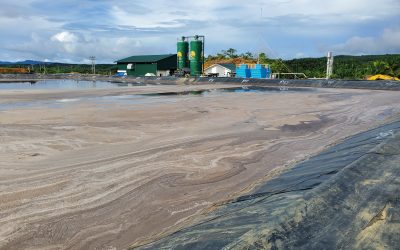
A new palm oil mill in Kutai Timur, East Kalimantan, is processing 60 tonnes of fresh fruit bunches an hour and with them, up to 600 cubic metres a day of palm oil mill effluent (POME) carrying a chemical oxygen demand (COD) of roughly 100,000 g/m³. That's an enormous...
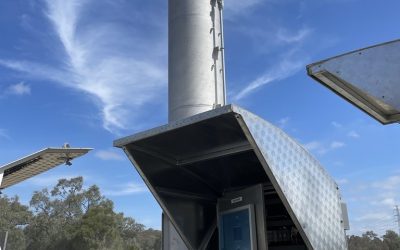
The problem SBI Group runs a landfill site in Victoria, Australia, and needed to deal with residual odour from its landfill gas stream. The gas doesn't arrive clean: it's a lean, wet mixture — 25% to 50% methane by volume, saturated with moisture, carrying 0% to 5%...